

How to Become a CFO in a Startup
Apr 23, 2026
A lot of finance professionals have the same long-term goal: becoming a CFO.
But the path to becoming a CFO in a startup or scaleup looks very different to the traditional corporate route. In large companies, the learnings, growth and promotions can be very structured. You might move from Financial Controller to Finance Director, and eventually to CFO over a number of years.
Startups rarely work like that.
In startups, people are often promoted much faster. Finance leaders are expected to take on strategic responsibilities earlier, and the role itself is usually much broader than people expect.
So if becoming a CFO is your goal, it’s worth understanding what founders actually expect from a startup CFO, and how to build the right skills before the opportunity appears.
First: Understand What a Startup CFO Actually Does
Many finance professionals assume the CFO role is mostly about reporting, forecasting, and managing the finance team.
Those things are part of the job, but they are not the core of the role in a startup.
In early-stage and growth companies, the CFO is often responsible for:
- cash management and runway planning
- fundraising and investor communication
- strategic planning with the founder
- building the finance function from scratch
- helping the leadership team make commercial decisions
In other words, the CFO is not just responsible for producing numbers. The CFO helps the business decide what to do next.
That’s a very different mindset from traditional accounting roles.
Step 1: Become Excellent at the Fundamentals
Before moving into leadership, you need strong technical foundations.
This includes things like:
- management accounts and financial reporting
- budgeting and forecasting
- cashflow modelling
- understanding revenue and cost drivers
Startups move quickly, and founders need finance leaders who can produce reliable numbers without needing weeks to analyse everything.
If the fundamentals are weak, it becomes much harder to earn trust with founders and investors later.
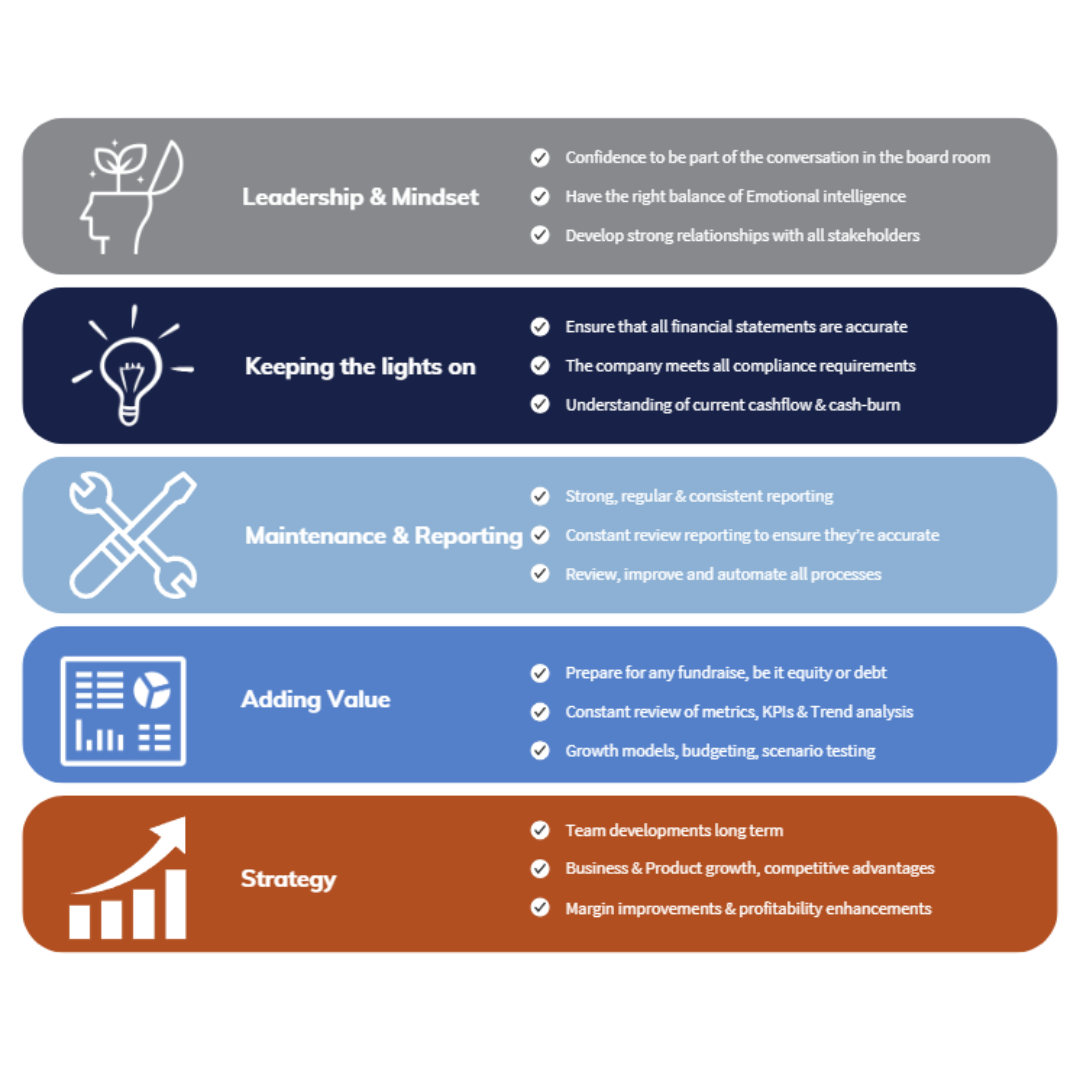
Here is our FLF Framework. You can see that "Keeping the Lights On", the foundations come long before Strategy....
Step 2: Learn How the Business Actually Works
One of the biggest differences between finance managers and CFOs is commercial understanding.
Good CFOs understand how the company makes money. They know:
- what drives revenue growth
- which products or channels are profitable
- how marketing spend converts into sales
- where costs can scale too quickly
If you want to become a CFO, you need to spend time understanding the commercial side of the business, not just the finance systems.
That often means spending more time with sales, marketing, and operations teams.
Step 3: Get Comfortable with Uncertainty
Large companies often have established processes and predictable cycles. Startups rarely do.
You might join a business where:
- the finance systems are messy
- reporting processes are inconsistent
- forecasting assumptions change every month
Part of the CFO role is bringing structure to that environment without slowing the business down. That requires a different skill set than simply maintaining existing systems. Introduction of corporate governance, growing pains, organisational structure is often led by both CEO and CFO.
Step 4: Build Leadership Skills Early
A CFO is not just a technical expert. They are part of the leadership team. That means you need to develop skills like:
- communicating financial insights clearly
- influencing decisions across the business
- presenting to founders and boards
- challenging assumptions when needed
Many finance professionals underestimate how important these leadership skills are. Being able to explain numbers to non-finance people is often what separates future CFOs from strong finance managers.
Step 5: Seek Exposure to Strategic Work
One of the best ways to prepare for a CFO role is to get exposure to strategic work earlier in your career. This could include things like:
- helping build financial models for fundraising
- supporting investor reporting
- participating in board meetings
- working on hiring or expansion plans
Even if you’re not leading those conversations yet, observing them helps you understand how senior leadership teams make decisions. Over time, that experience becomes invaluable.
Step 6: Understand That Timing Matters
In startups, becoming a CFO is often about timing as much as experience. Many people step into the role when a company suddenly needs someone to take ownership of the finance function.
That’s why it helps to develop the skills before the title arrives. If you already understand strategy, communication, and commercial drivers, the transition becomes much easier when the opportunity appears.
Becoming a CFO or a finance leader in a startup often includes gradually taking on the responsibilities of the role before you officially have the title. If you grow along with the business, then a CFO title will be more in your grasp. No-one is going to had you a CFO job title just because you have been in the business the longest and have always been the number 1 finance person. If you can't demonstrate the skills, then the founder and the board will hire a CFO above you.
So building strong technical foundations, developing commercial awareness, and learning how to communicate financial insights clearly to the rest of the business. The earlier you start building those skills, the easier the transition becomes when the opportunity appears.
Want to become a confident, strategic finance leader in a startup within the next 12 months?
Here’s your plan:
- Subscribe to my YouTube channel and Newsletter for weekly practical tips and real talk about startup finance leadership.
- Read my book Financial Leadership Fundamentals to get clear on what’s expected of you and how to show up as a leader.
- Join the Financial Leadership Fundamentals course to fast-track your growth with structure, support, and strategy that works in the real world.