

Why Some Finance Directors Never Become CFOs
May 07, 2026
A lot of finance professionals assume that becoming a CFO is the natural next step in their career.
You move from Finance Manager to Financial Controller, then Finance Director… and then CFO.
But in startups and scaleups, that progression often breaks.
Some Finance Directors make the step up quickly. Others don’t, even with years of experience. The difference is not technical ability. It’s how they operate in the role.
Here are the main reasons why some Finance Directors never become CFOs.
1. They Stay Too Focused on Reporting
Finance Directors are often excellent at:
- producing accurate management accounts
- running a clean month-end
- managing audit and compliance
But CFOs are not judged on reporting and delivering a really slick management accounts pack and accurate, useful reports. Instead, they’re judged on:
- decisions
- direction
- impact
If your value is still tied to, “the numbers are correct”, then you’ll struggle to move forward.
CFOs are expected to answer:
- what does this mean?
- what should we do next?
If you’re not doing that already, you won’t be seen as ready.
Next time you pull your management accounts pack together, start asking yourself the question, "what do these results tell me about the future?". How can you use this information?
2. They Don’t Fully Understand the Business
This is a big one.
Many Finance Directors stay too close to finance and not close enough to the business.
They know:
- the P&L
- the variances
- the reports
But they don’t fully understand:
- how revenue is generated
- which customers or products drive profit
- how marketing and sales actually convert
And critically in startups, it might also be how long the business has before it runs out of cash
If you can’t link financial data to:
- growth
- strategy
- runway
you won’t be brought into the conversations that matter. Again, use the numbers to help you with these areas.
3. They Don’t Influence Decisions
Being “in the room” is not the same as influencing what happens in the room.
Some Finance Directors, stick to what they know and only think about "finance" topics. They:
- present the numbers
- answer questions
- stay neutral
CFOs don’t do that. They don't just think about "finance" only and not the rest of the business. Instead, they
- challenge assumptions
- offer a point of view
- guide decisions
That requires confidence, but also clarity and insight. If you’re waiting to be asked, you’re already behind.
If you want to be able to find your voice in a board room, take a look at this post.
4. They Get Stuck in the Detail
This is also very common.Strong finance professionals are often detail-driven, which is very useful early in your career.
But at CFO level, it becomes a problem if you:
- review everything
- get pulled into operational tasks
- don’t step back
You need to move from doing the work to deciding what work matters
If you’re still heavily involved in:
- reconciliations
- detailed reviews
- fixing processes
you won’t have time for strategic work.
I will also say this can be a problem with Reporting as well. I have taken over from a CFO before who was let go because of these issues. The prior board back was pages and pages of detailed numbers. The board don't want to see that. They want to see what matters.
5. They Don’t Build a Team Around Them
You can’t operate as a CFO without a team.
Some Finance Directors struggle to:
- delegate
- trust others
- step away from the detail
So they become a bottleneck. They may have a team, but they aren't utilising the team properly and therefore they can't grow a team. The finance team also won't be happy with this set up either.
Instead, a CFO builds:
- structure
- clear ownership
- capability within the team
If everything still runs through you, you won’t scale into the role.
6. They Don’t Think Ahead
Finance Directors often focus on:
- what has happened
- what needs fixing
CFOs focus on:
- what’s coming next
- what needs to change
- what risks are ahead
If you’re not thinking ahead, you’re always reacting. Step away from fire-fighting and carve out time to think and plan.
7. They Wait for the Title
This is probably the biggest mistake.
Some Finance Directors wait until they are promoted to start acting like a CFO.
In startups, it works the other way around.
You become a CFO by:
- taking ownership early
- stepping into strategic conversations
- building relationships across the business
The title usually follows the behaviour.
You don't want to be told that a CFO has been hired above you to find out that you haven't demonstrated the skills. It's a tough pill to swallow. I know, it's happened to me before, early in my career and it's heartbreaking. But in hindsight, I wasn't behaving as a CFO and so the business made the right decision.
The gap between Finance Director and CFO is not about experience.
It’s about how you operate.
The people who make the transition move beyond reporting. They understand the business and are able to influence decisions. They can build teams around them and really take the time to think ahead
And they do that before they get the title.
If you’re working towards a CFO role, this is where to focus.
Not more technical knowledge. But how you show up in the business.
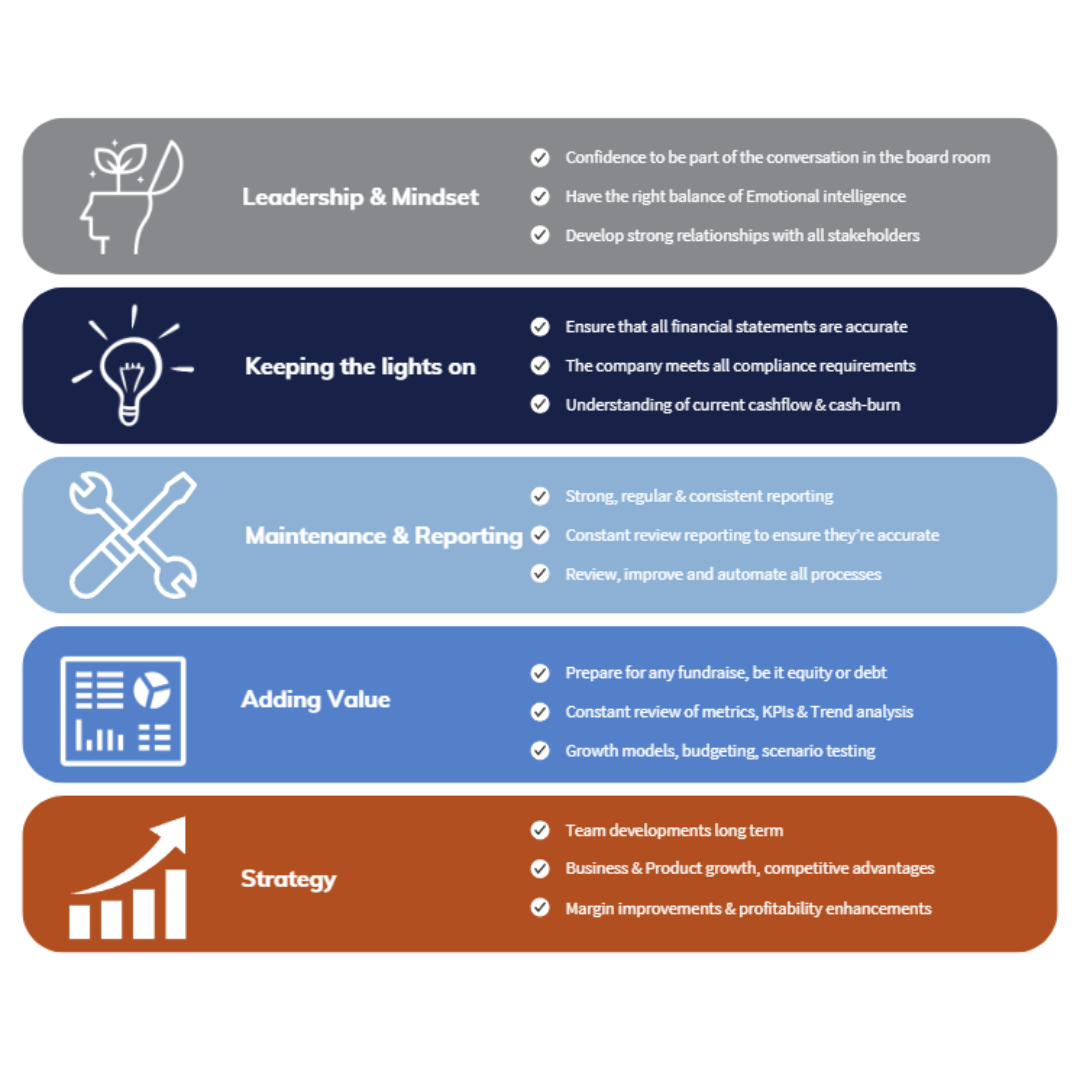
We created the FLF Framework to help with this transition, you can see this below:
___
This is part of a series on becoming a CFO in a startup. You might also find these useful:
Want to become a confident, strategic finance leader in a startup within the next 12 months?
Here’s your plan:
- Subscribe to my YouTube channel and Newsletter for weekly practical tips and real talk about startup finance leadership.
- Read my book Financial Leadership Fundamentals to get clear on what’s expected of you and how to show up as a leader.
- Join the Financial Leadership Fundamentals course to fast-track your growth with structure, support, and strategy that works in the real world.